When Yesterday Becomes the Enemy of Today: How Nostalgia Can Quietly Undermine Your Marriage
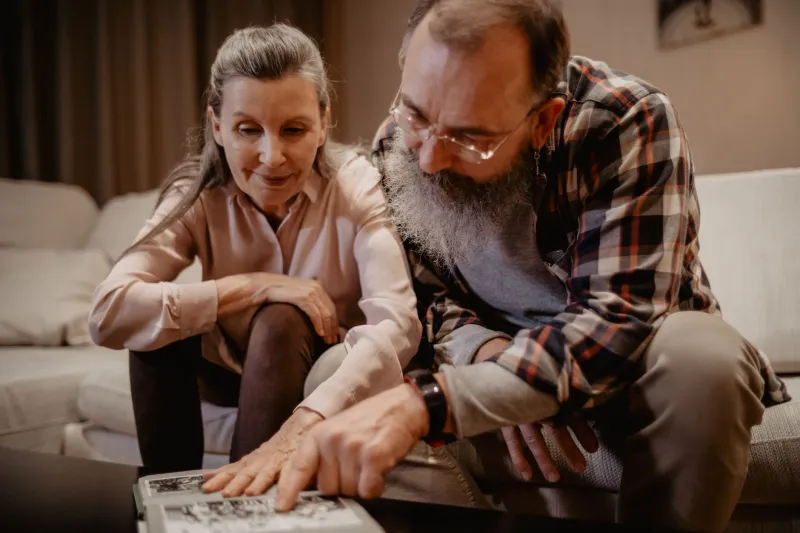
The Past Was Never as Perfect as You Remember
There is a particular kind of marital dissatisfaction that does not announce itself loudly. It does not arrive with a dramatic argument or a sudden betrayal. Instead, it seeps in slowly, carried on the back of a quiet but persistent thought: We used to be so much better than this.
For millions of American couples, nostalgia functions less like a warm memory and more like a measuring stick — one that the present relationship almost always loses against. The first apartment, the spontaneous road trips, the hours-long phone calls, the feeling of being wholly and urgently wanted. These memories are real. But they are also, almost invariably, incomplete.
Cognitive psychologists refer to this as rosy retrospection — the well-documented tendency of the human mind to remember past experiences more favorably than they were actually lived. When couples fall into the nostalgia trap, they are not simply remembering their early relationship. They are remembering a curated, emotionally filtered version of it, stripped of the anxiety, the uncertainty, and the very real difficulties that existed alongside the excitement.
The danger is not in having fond memories. The danger is in using those memories as a verdict on the present.
Why the Honeymoon Phase Was Never Meant to Last
Relationship science has long established that romantic love moves through distinct phases. The early stage — often called limerence or the honeymoon phase — is characterized by elevated dopamine and norepinephrine activity in the brain. In practical terms, this means heightened attention, idealization of the partner, and a near-constant preoccupation with the relationship. It feels extraordinary because, neurologically speaking, it is extraordinary.
It is also temporary by design.
As couples move through years together, the brain's reward circuitry shifts. The neurochemical cocktail that fuels infatuation gives way to systems associated with attachment, security, and companionship — oxytocin and vasopressin rather than dopamine surges. This is not a failure of the relationship. It is, in fact, its maturation.
Dr. Helen Fisher, a biological anthropologist whose research has shaped much of what we understand about love's stages, has described this transition as moving from "romantic love" to "companionate love" — a bond that, while quieter, is often more durable and more deeply sustaining. The problem arises when couples interpret this neurological shift as evidence that something has gone wrong, rather than recognizing it as evidence that something has grown.
When a husband tells his therapist, "I just don't feel that spark anymore," he may be accurately describing a change in neurochemical intensity. But if he concludes from that observation that his marriage is failing, he is confusing a natural transition with a crisis.
The Resentment Cycle That Nostalgia Creates
Constantly comparing a current marriage to its earliest chapter does more than breed disappointment — it generates a specific and corrosive form of resentment. When one or both partners become fixated on recapturing a feeling that was always meant to evolve, they begin to experience the ordinary rhythms of a mature partnership as deficiencies.
The comfort of a familiar routine becomes evidence of stagnation. The ease of a long-shared life becomes proof of lost passion. A partner who once felt like an exciting discovery now feels, unfairly, like a disappointment — not because they have changed for the worse, but because they have been measured against an impossible standard.
This resentment is particularly insidious because it is rarely directed at anything the partner has actually done. It is directed at what the relationship has become — which is to say, at the natural passage of time itself. Couples caught in this cycle often report feeling vaguely dissatisfied without being able to articulate why, which makes it especially difficult to address in conversation.
Left unexamined, nostalgia bias can quietly erode the goodwill and mutual appreciation that sustain a long-term partnership through its inevitable difficulties.
Reframing the Seasons of a Marriage
A more constructive framework is to think of marriage not as a single, continuous emotional experience that should always feel the same, but as a relationship with distinct and equally valuable seasons.
The early season offers intensity and discovery. The middle seasons — marked by shared responsibilities, children, careers, and the accumulation of lived history — offer something the early days could not: depth. There is an intimacy available to a couple who has navigated a financial crisis together, grieved a loss together, or rebuilt trust after a period of disconnection that simply does not exist in the first flush of romance. It is harder-won and, for that reason, more meaningful.
Counseling professionals often encourage couples to develop what might be called a relational autobiography — a shared narrative that honors the full arc of the relationship rather than privileging only its beginning. When couples can articulate not just where they started but how they have grown, adapted, and chosen each other repeatedly across time, the present chapter of the marriage gains context and value that nostalgia alone cannot provide.
Practical Strategies for Couples Ready to Invest in the Present
If you recognize the nostalgia trap in your own relationship, the following approaches can help redirect your attention toward the partnership you actually have.
Name the bias when it appears. When you catch yourself thinking, "We never used to argue about this" or "Things were so much easier before," pause and ask yourself whether that memory is complete. What was also true during that period that you are not remembering?
Practice deliberate appreciation of the present relationship. Research on gratitude in marriage consistently shows that partners who regularly identify and acknowledge specific things they value about their spouse report higher relationship satisfaction. This is not about manufactured positivity — it is about training attention toward what exists rather than what is absent.
Create new shared experiences intentionally. One reason the early relationship feels vivid is that it was filled with novelty. Novelty is not exclusive to new relationships. Couples who pursue new activities, travel to unfamiliar places, or engage in shared learning together report sustained feelings of connection and excitement. The goal is not to recreate the past but to generate new memories worth keeping.
Seek professional support when the pull of the past feels overwhelming. A licensed marriage and family therapist can help couples identify whether nostalgia is functioning as a symptom of a deeper unmet need — for attention, for adventure, for emotional intimacy — and develop strategies for addressing that need within the current relationship.
Distinguish between nostalgia and legitimate unmet needs. Not every longing for the early days is pure bias. Sometimes, the things a couple misses — regular affection, playfulness, prioritized time together — are genuinely absent and worth reclaiming. The distinction lies in whether the goal is to recreate a feeling or to address a real gap in the present relationship.
The Marriage You Have Is Worth Choosing
Long-term partnership asks something of us that the early days never did: the willingness to love not the idealized version of a person, but the actual one — complete with history, complexity, and change. That is a more demanding form of love. It is also a more honest and, ultimately, more rewarding one.
The couples who report the greatest satisfaction in long marriages are rarely those who managed to sustain the feeling of the honeymoon phase indefinitely. They are the ones who learned to find meaning in what replaced it — the quiet loyalty, the hard-earned understanding, the accumulated grace of choosing each other not once, but continuously.
Your early relationship was a beginning, not a standard. The marriage you are building now deserves to be measured on its own terms.